Most Efficient Solar Panels 2026: Top 15, up to 25.5%
Why Efficiency Matters (and When It Doesn't)
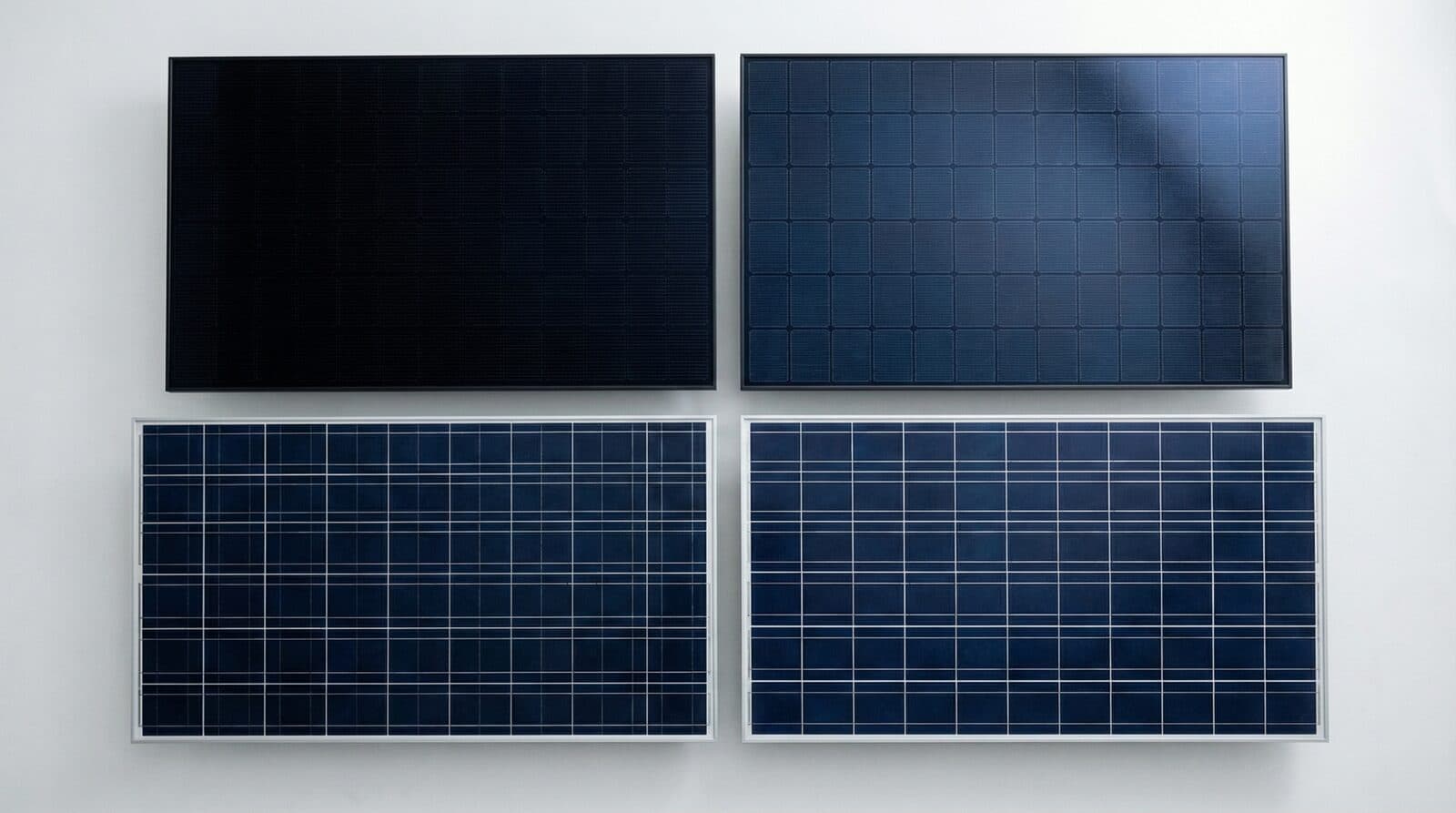
Solar panel efficiency measures how much sunlight a panel converts into electricity. The most efficient residential panels in 2026 reach 25–25.5%, up from 20–21% just five years ago. That means a modern 25% panel generates the same power as a 2020-era panel in 80% of the space — a meaningful difference if your roof is small or oddly shaped.
But here's the nuance most rankings miss: the number on the datasheet is measured at 25°C under perfect lab conditions (STC). On your actual roof at 50–65°C, every panel loses power — and some lose far more than others. A 25% STC panel with a poor temperature coefficient can produce less real-world energy than a 23% panel with excellent heat tolerance. This guide ranks panels by both STC and real-world performance, using actual datasheet specs from our equipment database.
What STC efficiency really means
What Changed Since 2025
The efficiency landscape has shifted meaningfully in the past 12 months. Back-contact technologies — ABC, HPBC and HIBC — moved from niche to volume (about 16% of the module shipments InfoLink tracked in the first half of 2026); silicon-cell records crossed 28% in April; SNEC and Intersolar reset the flagship bar to 690–700 W; and over the summer the first of those launches turned into datasheets. Here's what's new since our March 2026 first edition (last re-verified 3 September 2026):
- LONGi Hi-MO S10 takes HIBC to 690 W and 25.5% — and the top of our ranking.LONGi's heterojunction back-contact (HIBC) line now ships as Hi-MO S10: a 72-cell module rated 665–690 W at up to 25.5% on LONGi's May 2026 datasheet, and a 54-cell residential version at 495–510 W / 25.0%, sold to homeowners in Europe under the EcoLife brand. Both carry a −0.24%/°C temperature coefficient; the dual-glass 72-cell adds 60±5% bifaciality, with 15 years of product and 30 years of performance warranty at 0.35%/yr. Both datasheets are in our equipment database, so the S10 replaces the "Hi-MO 9 EcoLife" entry of earlier editions. LONGi's half-year report (31 August) puts back-contact at 19.55 GW — more than 65% of its module sales.
- AIKO: third-generation INFINITE already reaches 690 W / 25.5%; fourth-generation ULTRA datasheets are published, deliveries are not.AIKO's own product pages now list the third-generation Comet 3N72 at 655–690 W — 25.5% module efficiency at the top bin, on a datasheet revised in January 2026 — so the "Gen 3 = 25.0%" figure we quoted in earlier editions is out of date. The fourth-generation INFINITE ULTRA, launched at Intersolar on 23 June, brings the same 25.5% to a 510 W 54-cell residential format (Neostar 54) and to a 690 W Stellar 72; AIKO quotes 25.6% and a 26% peak. Its datasheets are published and in our database, but as of 3 September AIKO has not announced first deliveries — the promise remains "Q3 2026". The Z Series (500 W, all-black, 40-year product and performance warranty) is on pre-order through nine European distributors with no ship date. AIKO shipped 9.39 GW of ABC modules in the first half of 2026 and entered InfoLink's top-10 for the first time.
- JinkoSolar's Tiger Neo 5.0 (700 W / 25.91%) still has no datasheet; Tiger Neo 3.0 is what ships.Three months after the SNEC unveiling, JinkoSolar's second-quarter results (26 August) repeat the 25.91% / 700 W headline but publish no datasheet, no temperature coefficient and no delivery date, so Tiger Neo 5.0 moves out of our ranking table and into the "What's next" box until a datasheet exists. Tiger Neo 3.0 is the volume product — 670 W / 24.8% / −0.26%/°C with 85±5% bifaciality, the highest among commercial TOPCon modules; JinkoSolar says more than 40 GW of capacity is being upgraded to it and that it sells at a premium of roughly US$0.10/W. At cell level JinkoSolar's TOPCon record is 27.79% (ISFH, November 2025); its 26.66% mass-production M10 cell of February 2026 was certified by an undisclosed Chinese laboratory, and the company projects crossing 28% by 2028.
- Silicon-cell records crossed 28% in April — and a 28.2% back-contact claim followed in May.On 27 April 2026 Trinasolar announced 28.00% for a TOPCon-compatible Hybrid Back Contact (THBC) cell on a 210R wafer, certified by ISFH — the first large-area silicon cell past 28%; Trina now targets THBC mass production in the second half of 2026. Less than 24 hours later LONGi reclaimed the record with 28.13% on a HIBC cell, also ISFH-verified. In late May JA Solar and Gold Stone Energy claimed 28.2% for an HBC cell certified by TÜV Rheinland; the Solar Cell Efficiency Tables (version 68, July 2026) and the NLR efficiency chart still list LONGi's 28.1% as the record, since TÜV Rheinland is not one of the tables' designated laboratories. JA Solar's first back-contact module, HyperGen, was announced on 31 August without specifications. The Shockley–Queisser limit for single-junction silicon remains 33.7%.
- TCL and Canadian Solar publish the datasheets behind their 24.8% modules.TCL Solar's C2 L (HSM-BD66-GR, 645–670 W, n-type back-contact, 24.8%, −0.26%/°C, 75% bifaciality) received a European datasheet in August 2026, together with the residential C2 S Black (485–495 W, 24.3%) — TCL's first published back-contact specs, so the brand enters our ranking. Canadian Solar's TOPCon Gen3 (CS6.3-66TB, 645–670 W, 24.8%, −0.26%/°C, 85% bifaciality) has a June 2026 datasheet and "mass shipments from August 2026" per the company's statements of 5 and 28 August; we list it with that flag. All four datasheets were imported into our equipment database for this update. TCL's C3 (680 W / 25.2% in mass production since May, above 710 W and 26% shown at SNEC) still has no datasheet; TCL is supplying 720 MWp of 24.2% back-contact modules to Australia's Smoky Creek and Guthrie's Gap plants, and its acquisition of DAS Solar lifts its back-contact cell capacity to 20 GW.
- Maxeon's judicial management deepened; Meyer Burger's HJT IP went to Swift Solar.Since our July edition Maxeon has licensed its patents and trade secrets to TCL's Zhonghuan for US$8 million (22 May), received demands for immediate repayment under all three of its note indentures (18 June), lost its CFO (effective 14 August) and seen its patent suits against Canadian Solar dismissed with prejudice (19 August). Its shares trade over the counter for a fraction of a cent, no buyer or restructuring plan has been announced, and the warranty page now signs as "Maxeon Solar Technologies, Ltd. (under Judicial Management)". Maxeon 7 stays in our database at 24.1% module efficiency, but we have moved it out of the ranking table: treat availability and the famous 40-year warranty as open questions. Meyer Burger filed Chapter 11 in June 2025 and ceased US production; Swift Solar acquired its HJT intellectual property in March 2026 and has announced no factory since. REC Alpha Pure-RX and Huasun Himalaya fill the low-temperature-coefficient niche.
- Perovskite-silicon tandems: LONGi's 35.5% cell stands, and LONGi is now funding a 100 MW pilot line.On 14 July 2026 LONGi raised the tandem-cell world record to 35.5% (ESTI-certified) — its third record in fifteen months after 34.85% and 35.2% — and, less noticed, reported certified tandem modules at 31.4% (0.17 m²) and 29.4% (1.7 m²). On 14 August it approved a 100 MW tandem pilot line worth about CNY 204 million, so "no mass-production plan" is no longer true, though a pilot line is not a product. Elsewhere: JinkoSolar reached 34.82% on a perovskite/TOPCon tandem cell (SIMIT-certified, 19 June); Trinasolar's 907 W / 29.2% full-size tandem module (TÜV SÜD, 1 June) is pencilled in for small-scale production in 2028–29; Qcells' tandem became the first to be certified to IEC 61215 and UL 61215 (TÜV Rheinland, 16 July) ahead of 2027 mass production in Jincheon, Korea; GCL Optoelectronics ships China's first commercial tandem order (1.2 MW, 25-year performance warranty) from the end of Q3 2026; Tandem PV shipped a first production-quality panel in late July, reports 30.4% on a 100 cm² demonstration module and won a US$7.7 million ARPA-E award on 26 August, but has no commercial sale yet. Huasun has announced nothing new for its 100 MW HJT-perovskite pilot line, and Oxford PV's module record stays at 26.9%.
- IEC 61215:2021 compliance is now mandatory for most subsidy programs.Since 1 April 2025 most EU and US incentive programs require certification under IEC 61215:2021 and IEC 61730:2023, with their intensified hail-ball, UV, and temperature-range tests. Older certifications are no longer accepted, and budget imports without the new stamp can disqualify you from rebates.
- Trade-show launches are turning into datasheets — slowly.Of the SNEC and Intersolar announcements we listed in June and July, three now have final documents: AIKO's INFINITE ULTRA, TCL's C2 and Canadian Solar's TOPCon Gen3. Still announcement-only: Tongwei's TNC 3.0 (770 W / 24.8%, "in mass production" per its half-year report but with no datasheet on its site), Trina's Vertex N G3 at 760 W, Huasun's Himalaya PLUS at 760 W (a first export order of 100 MW to Pakistan on 19 August, no datasheet), Astronergy's ASTRO N8 Pro at 825 W, LONGi's Hi-MO 9 Prime (680 W / 25.2%) and TCL's C3. Trina did put a higher residential module into production — Vertex S+ G3 at 515 W / 24.7% / −0.26%/°C (TSM-NEG10R.28Z), shipping since July — but only in Australia and without a public datasheet, so our table keeps the 485 W / 24.3% version sold elsewhere. The next launch window is RE+ in Las Vegas, which moved this year to 16–19 November.
- Prices cooled over the summer, back-contact stays scarce — and the US sets a price floor.pvXchange's July index put high-efficiency n-type modules at €0.145/Wp (−3.3% on June), mainstream at €0.135 and full-black at €0.160; in August it reported "little change, with some segments even seeing renewed declines" as production surpluses built up, and expects no significant further declines this year. sun.store's July index: full-black €0.138/Wp, back-contact €0.135, bifacial TOPCon down to €0.11 — its lowest since February. InfoLink's 2 September assessment has Chinese-made TOPCon delivered to Europe at an average of US$0.119/W, back-contact for commercial roofs at $0.131/W and all-black back-contact for homes at $0.195/W. The one segment still short is back-contact above 24%, where pvXchange reports demand exceeding supply: only AIKO, LONGi and TCL build it at scale, and back-contact was roughly 30 GW — about 16% of the module market — in the first half of 2026 (InfoLink). In the United States, the Section 232 proclamation of 6 August introduces minimum import prices from 4 December 2026 — US$0.38/W for modules and $0.22/W for cells — which puts a floor under imported panel prices there.
LONGi's 35.5% tandem record raised the ceiling again
What's next: announced, not yet ranked
Top 15 Most Efficient Solar Panels in 2026
These are the highest-efficiency residential and light-commercial solar panels available in 2026, ranked by module-level STC efficiency computed from datasheet power and dimensions. Every row is backed by a datasheet in our equipment database, and each panel name links to its catalogue page. What changed in the September 2026 update: LONGi's Hi-MO S10 (HIBC, 690 W / 25.5%, −0.24%/°C) takes first place — it had been in our database since April but not in this table; AIKO's third-generation Comet 3N72 joins it at 690 W / 25.5%, and the fourth-generation Neostar 54 (510 W / 25.5%) and Z Series (500 W, 40-year warranty) appear with availability flags. TCL Solar's C2 L and Canadian Solar's TOPCon Gen3 enter at 670 W / 24.8% on datasheets published in August and June. Huasun's row is corrected to the 750 W / 24.1% bin we hold. Leaving the table: JinkoSolar Tiger Neo 5.0 (no datasheet), Maxeon 7 (24.1%, company under judicial management), Tongwei TNC 2.0 and Risen Hyper-ion Pro (24.1% and 24.0%, edged out), and Canadian Solar's older TOPBiHiKu7. REC Alpha Pure-RX (22.8%) stays our hot-climate pick below.
| Panel | Technology | Efficiency | Power | TcPmax (%/°C) |
|---|---|---|---|---|
| LONGi Hi-MO S10 (72-cell) | HIBC | 25.5% | 690 W | −0.24 |
| AIKO Comet 3N72 (INFINITE) | ABC | 25.5% | 690 W | −0.26 |
| AIKO Neostar 54 Gen 4 (INFINITE ULTRA; deliveries not yet confirmed) | ABC | 25.5% | 510 W | −0.26 |
| LONGi Hi-MO S10 (54-cell, EcoLife) | HIBC | 25.0% | 510 W | −0.24 |
| Recom Black Tiger | n-type BC bifacial | 25.0% | 510 W | −0.24 |
| AIKO Z Series (pre-order; 40-year warranty) | ABC | 25.0% | 500 W | −0.26 |
| LONGi Hi-MO X10 | HPBC 2.0 | 24.8% | 670 W | −0.26 |
| JinkoSolar Tiger Neo 3.0 | TOPCon | 24.8% | 670 W | −0.26 |
| JA Solar DeepBlue 5.0 | TOPCon | 24.8% | 670 W | −0.26 |
| Astronergy ASTRO N7 Pro | TOPCon | 24.8% | 670 W | −0.26 |
| TCL Solar C2 L | n-type BC bifacial | 24.8% | 670 W | −0.26 |
| Canadian Solar TOPCon Gen3 (shipping from Aug 2026) | TOPCon | 24.8% | 670 W | −0.26 |
| Phono Quasar N BC (108-cell) | IBC bifacial | 24.5% | 500 W | −0.26 |
| Trina Vertex S+ G3 | TOPCon | 24.3% | 485 W | −0.26 |
| Huasun Himalaya G12-132 | HJT | 24.1% | 750 W | −0.24 |
Notice the pattern: back-contact panels (HIBC, ABC, HPBC, IBC) fill the top of the table, but TOPCon holds the 24.8% tier with five brands and wins on $/W — and the latest n-type TOPCon (JinkoSolar, JA Solar, Astronergy, Canadian Solar, Trina) has narrowed the temperature coefficient gap to −0.26%/°C, just 0.02%/°C behind HJT and HIBC. The two 690 W leaders are tied on STC efficiency; Hi-MO S10 sits first because its −0.24%/°C coefficient gives it more energy once cells climb past 45°C. Three editorial flags: the Neostar 54 row is a published fourth-generation datasheet whose deliveries AIKO had not confirmed by 3 September (the Comet 3N72 row is the same 25.5% class shipping today); the Z Series is on pre-order; and Canadian Solar dated its Gen3 mass shipments to August without confirming first units. Tiger Neo 5.0, Maxeon 7 and the big HJT modules from Risen (745 W / 24.0%) and Huasun are discussed in the text below, as is Tongwei's TNC 2.0 (750 W / 24.1%).
Cell Technologies Explained: What Makes Them Different
PERC (Passivated Emitter Rear Contact) was the workhorse of 2018–2023. It uses p-type silicon with a rear passivation layer, reaching 20.5–22.5% efficiency. PERC is now being phased out — from 60% of global production in 2023 to 3% of China's cell output in 2025 (CPIA), with ITRPV counting about 14% of the modules shipped worldwide that year as PERC, mostly older stock. Its theoretical ceiling of ~24.5% means there's little room left to improve.
TOPCon (Tunnel Oxide Passivated Contact) is the current mainstream leader. It uses n-type silicon with an ultra-thin tunnel oxide layer for better electron collection, reaching 22–24.8% efficiency in shipping modules (25.91% is announced for Tiger Neo 5.0). TOPCon makes up roughly 83% of the module shipments InfoLink tracked in the first half of 2026 and 87.6% of China's 2025 cell output (CPIA), and has reached cost parity with PERC. Every major manufacturer (LONGi, Jinko, Trina, JA Solar, Canadian Solar, Astronergy, Tongwei) has fully transitioned, and the next step on the roadmap is quarter-cut cells — slicing each cell into four strips instead of two cuts resistive losses, which is how the 700 W+ flagships shown at SNEC 2026 get there. Cell-level records keep rising: JinkoSolar's mass-production M10 cell hit 26.66% in February 2026 (certified by an undisclosed Chinese laboratory) and its laboratory cell 27.79% (ISFH, November 2025); Trinasolar's THBC architecture (TOPCon-compatible Hybrid Back Contact) crossed 28.00% on 27 April 2026 — the first time a large-area 210R silicon cell did so — with mass production targeted for the second half of 2026.
HJT (Heterojunction) sandwiches crystalline silicon between amorphous silicon layers. This gives it the industry's best temperature coefficient (−0.24 to −0.26%/°C) and excellent bifaciality (85–95%). STC efficiency reaches 22.6–24.1% (Huasun's 750 W Himalaya G12 at 24.1%, Risen's 745 W Hyper-ion Pro at 24.0%), and real-world yield in hot climates can exceed TOPCon. The tradeoff: HJT costs 15–30% more per watt to manufacture. Cell records have climbed fast — Trinasolar set 27.08% in December 2024, and Risen reached 26.61% in mass production. 2026 also saw the bifacial gap narrow on the TOPCon side: JinkoSolar's Tiger Neo 3.0 and Canadian Solar's TOPCon Gen3 reach 85±5% bifaciality, the first time mainstream TOPCon matches HJT's rear-side gain.
IBC (Interdigitated Back Contact) puts all electrical contacts on the rear of the cell, eliminating front-side shading losses. Maxeon (formerly SunPower) pioneered this at 24.1% module efficiency and backs it with a 40-year product warranty — the longest in the industry. Important caveat: Maxeon has been under judicial management in Singapore since April 2026 (formalized 29 May); since then it has licensed its patents to TCL, received demands for immediate repayment of its notes, lost its CFO and seen its patent suits against Canadian Solar dismissed (19 August 2026), and no buyer or plan has been announced. The technology and IP remain best-in-class, but availability and warranty service are genuinely uncertain — verify with your distributor before committing, which is why Maxeon 7 sits outside the ranking table this time. The SunPower/Maxeon technology stack now sits under TCL, whose own C2 back-contact modules reached 24.8% in August 2026, and the next-generation Maxeon 8 (promised above 25%) has still not reached commercial launch.
ABC/HPBC (All Back Contact / Hybrid Passivated Back Contact) are next-generation back-contact technologies from AIKO and LONGi respectively. They combine TOPCon-like passivation with IBC's rear-contact architecture. AIKO's third-generation INFINITE modules already reach 690 W / 25.5% in the 72-cell Comet 3N72 (datasheet revised January 2026); the fourth-generation INFINITE ULTRA (Intersolar, June 2026) matches that in the Stellar 72 and brings 25.5% to the 510 W residential Neostar 54, on a 27.4% average cell efficiency — AIKO quotes 25.6% and a 26% peak, and had not confirmed first deliveries by 3 September. LONGi's HPBC 2.0 module record stands at 25.4% (Fraunhofer ISE), and its R&D HIBC module reached 26.4% in April 2026. TCL's back-contact line — E Class in China, C2 in Europe — reaches 670 W / 24.8% in the C2 L with a −0.26%/°C coefficient. Phono's Quasar N BC line adds bifacial gain — 500 W at 24.5% in the 108-cell residential format, 665 W in the 144-cell — useful when you still need rear-side yield on white roofs or ground mounts.
HIBC (Heterojunction Back Contact) is the newest entry: LONGi's Hi-MO S10 — launched in 2025 at 25.0% and sold to homeowners in Europe under the EcoLife brand — is the first mass-produced module to combine HJT passivation with a back-contact electrode. The 54-cell version delivers 25.0% at 510 W; the 72-cell version, on LONGi's May 2026 datasheet, 25.5% at 690 W. Both carry a −0.24%/°C temperature coefficient and 0.35%/yr linear degradation after a 1% first-year drop; the dual-glass 72-cell adds 60±5% bifaciality. Cell-level records have been climbing fast: from 27.3% at launch to 28.13% on 28 April 2026 (ISFH-verified), with JA Solar and Gold Stone claiming 28.2% for an HBC cell a month later (TÜV Rheinland). HIBC essentially fuses HJT's heat tolerance with the back-contact efficiency premium.
The technology that matters most
STC Efficiency vs Real-World Performance
This is where rankings get interesting — and where most comparison articles fail you. Every panel's datasheet lists efficiency at 25°C (STC), but your panels typically operate at 45–65°C. The temperature coefficient of Pmax (TcPmax) determines how much power you lose per degree above STC. Here's the formula our calculator uses:
Real-world power at elevated temperature
P_real = Pmax × (1 + (TcPmax / 100) × (T_cell − 25))

Example at 55°C cell temperature:
TOPCon: 500W × (1 + (−0.29/100) × 30) = 456.5 W (−8.7%)
HJT: 500W × (1 + (−0.24/100) × 30) = 464.0 W (−7.2%)| Technology | STC efficiency | TcPmax (%/°C) | Efficiency at 55°C | Power loss |
|---|---|---|---|---|
| PERC | 21.5% | −0.36 | 19.2% | −10.8% |
| TOPCon | 23.5% | −0.29 | 21.5% | −8.7% |
| HJT | 23.0% | −0.25 | 21.3% | −7.5% |
| IBC (Maxeon) | 24.1% | −0.27 | 22.1% | −8.1% |
| ABC/HPBC | 25.5% | −0.26 | 23.5% | −7.8% |
Look at the HJT row: it starts at 23.0% STC — lower than TOPCon's 23.5% — but at 55°C it's only 0.2% behind (21.3% vs 21.5%). In hotter climates where cells reach 65°C, HJT actually overtakes TOPCon in real energy output. The datasheet ranking and the real-world ranking are not the same.
Don't compare STC numbers in hot climates
Check the IEC 61215:2021 stamp before you buy
The N-Type Revolution: Why PERC Is Dead
The solar industry has undergone its biggest technology shift since monocrystalline replaced polycrystalline. P-type PERC cells — the standard from 2018 to 2023 — have been almost entirely replaced by n-type technologies. In 2023, PERC held 60% of global production. By 2025 it was 3% of China's cell output (CPIA) and about 14% of global module shipments (ITRPV, June 2026), and ITRPV expects it to disappear from the roadmap entirely.
N-type silicon (used in TOPCon, HJT, and all back-contact technologies) is inherently superior: it has no boron-oxygen defects that cause light-induced degradation (LID), it tolerates higher temperatures better, and its theoretical efficiency ceiling is higher. The main reason PERC lasted so long was cost — n-type silicon and the required manufacturing processes were more expensive. That price gap closed in 2024–2025 as TOPCon reached manufacturing cost parity with PERC.
If you're buying panels in 2026 and a dealer offers you PERC panels at a discount, think carefully. You'll get lower efficiency (20–22% vs 22–25%), worse temperature performance, faster degradation (0.55–0.70%/yr vs 0.40–0.50%/yr), and a technology with no future development roadmap. The savings per watt rarely justify the lifetime energy loss.
How to tell N-type from P-type
Climate-Specific Picks: Best Panel for Your Conditions
Rankings tell you which panel has the highest STC number. Climate context tells you which one will actually produce the most energy on your roof. Use this table as a starting point — then verify string compatibility with our tools.
| Use case | Recommended technology | Top picks |
|---|---|---|
| Hot / desert (summer ambient >35°C) | HJT or HIBC (best TcPmax) | LONGi Hi-MO S10, REC Alpha Pure-RX, Huasun Himalaya G12 |
| Cold / mountain (winters below −20°C) | TOPCon or HJT (verify Voc-cold vs inverter) | LONGi Hi-MO X10, Trina Vertex S+ G3, JinkoSolar Tiger Neo 3.0 |
| Limited roof (under 30 m²) | Back-contact (ABC / HPBC / HIBC / IBC) | LONGi Hi-MO S10, AIKO Comet 3N72 / Neostar 54, Recom Black Tiger |
| Partial shade (trees, chimneys, dormers) | Half-cut TOPCon with microinverters / optimizers | JinkoSolar Tiger Neo 3.0, JA DeepBlue 5.0, Astronergy ASTRO N7 Pro |
| Coastal / salt-spray / high humidity | HJT with IEC 61701 salt-mist certification | Huasun Himalaya G12, REC Alpha Pure-RX, AIKO INFINITE (IEC 61701-certified) |
Anti-dust coatings matter in arid regions
Match panels with your inverter
Found a panel you like? Use the matcher to see which inverters in our database deliver a compatible string count, MPPT window, and current headroom for your climate.
Efficiency vs Price: Finding the Sweet Spot
Higher efficiency costs more per watt — but how much more, and when is it worth it? One important 2026 shift first: after China abolished its VAT export rebate on 1 April 2026, European spot prices rebounded 10–15%, stalled in July and cooled in August — pvXchange reports "little change, with some segments even seeing renewed declines" as production surpluses build up, and expects no significant further declines this year. The exception is back-contact above 24%, which remains supply-constrained (only AIKO, LONGi and TCL build BC at scale). Volume BC has commoditized faster than expected all the same: InfoLink's 2 September assessment puts Chinese-made TOPCon delivered to Europe at $0.119/W on average, back-contact for commercial roofs at $0.131/W and all-black back-contact for homes at $0.195/W — a fraction of what Maxeon-class IBC imports cost. In the US, minimum import prices of $0.38/W for modules apply from 4 December 2026 under Section 232. The $/W ranges below are global ballparks; in Europe right now, expect the upper end of each range:
| Technology | Efficiency range | Module price ($/W) | Best for |
|---|---|---|---|
| PERC (legacy) | 20.5–22.0% | $0.10–0.18 | Budget projects only |
| TOPCon | 22.0–24.8% | $0.12–0.22 | Best all-around value |
| HJT | 22.6–24.1% | $0.18–0.28 | Hot climates, premium installs |
| Back-contact (ABC/HPBC/HIBC/IBC) | 24.1–25.5% | $0.15–0.40 | Space-limited roofs |
The key insight: efficiency premium only matters when roof space is limited. If you have ample space, a 22% TOPCon panel at $0.15/W produces cheaper electricity over its lifetime than a 25% back-contact panel at $0.40/W — you just need 14% more roof area. But if your usable roof is 20 m² and you need 5 kW, that extra 3% efficiency is the difference between fitting the system or not.
The real cost metric: $/kWh over 25 years
Warranty & 25-Year Degradation: The Long-Term View
Efficiency at year 1 is what rankings focus on. Efficiency at year 25 is what actually pays your electricity bill. Panels degrade — n-type panels slower than PERC, flagship brands slower than bulk imports. Here's what today's top panels are warranted to deliver after a quarter-century:
| Panel | Product warranty | Annual degradation | Guaranteed output at year 25 |
|---|---|---|---|
| Maxeon 7 (IBC) | 40 years | 0.25%/yr | ~92.0% |
| REC Alpha Pure-RX (HJT) | 25 years | 0.25%/yr | ~92.0% |
| AIKO INFINITE (ABC) | 15 years (extendable to 25) | 0.35%/yr | ~87.4% |
| LONGi Hi-MO X10 (HPBC 2.0) | 15 years | 0.35%/yr | ~87.4% |
| TOPCon (industry average) | 12–15 years | 0.40–0.50%/yr | ~85–88% |
Maxeon is the warranty outlier on paper — 40 years is unmatched by any shipping mainstream product — but with the company in judicial management since May 2026, its notes accelerated, its CFO gone and no buyer announced as of September, that guarantee is only as good as whatever entity emerges from restructuring. Confirm the warranty backstop before relying on it. AIKO's Z Series (500 W residential, on pre-order in Europe) promises the same 40-year product and performance warranty from a financially healthy manufacturer, and its datasheet is published — worth waiting for a ship date. REC matches Maxeon on degradation, stops the product warranty at 25 years, and is operationally stable. AIKO's INFINITE line offers 15 years of product warranty, extendable to 25, and LONGi the typical 15/30 split. Average TOPCon panels lose about 12% more output over 25 years than Maxeon — equivalent to one missing year out of every eight.
Read the warranty fine print
Perovskite Tandem: The Next Frontier
The most exciting efficiency breakthrough isn't in silicon at all — it's in perovskite-silicon tandem cells. LONGi set the current world record at 35.5% on 14 July 2026 (ESTI-certified) — its third record in fifteen months, after 34.85% and 35.2% — pushing far past the theoretical limit of single-junction silicon (33.7%) with a stacked two-junction design. By layering a perovskite cell (tuned for blue/green light) on top of a silicon cell (tuned for red/infrared), tandems capture more of the solar spectrum than either material alone. LONGi's certified tandem modules sit at 31.4% (0.17 m²) and 29.4% (1.7 m²). In July LONGi called the record a lab result with no mass-production plan; on 14 August it approved a 100 MW pilot line (about CNY 204 million) to work on the open problems — large-area deposition, yield, encapsulation and long-term stability. A pilot line is a first milestone, not mass production.
Several players are now visibly past the lab. On 1 June 2026 Trinasolar set the headline record: a full-size 3.1 m² tandem module measured at 907 W and 29.2% efficiency by TÜV SÜD — built on a mass-production 210 mm platform, with small-scale production pencilled in for 2028–29 and gigawatt capacity for 2029. JinkoSolar reported a 34.82% perovskite/TOPCon tandem cell (SIMIT-certified) on 19 June. Oxford PV shipped the first commercial perovskite-silicon tandem panels to a US utility customer in September 2024 at 24.5% efficiency; its module record stands at 26.9%, it showed 25.6% matrix-shingle prototypes with Fraunhofer ISE in June 2026, and its roadmap targets 26% products with a 15-year lifetime in 2026, rising to 27% and 20 years by 2027–28, with a new factory planned for late 2027 or early 2028. Tandem PV reports 30.4% on a 100 cm² demonstration module, shipped a first production-quality panel in late July, won a US$7.7 million ARPA-E award in August and plans paid pilots and first revenue sales later in 2026 at around $0.40/W, with gigawatt scale in 2028. Q CELLS holds a 28.6% tandem cell record on a full-area M10 cell and on 16 July 2026 became the first to certify a tandem module to IEC 61215 and UL 61215 (TÜV Rheinland); mass production is expected in 2027 in Jincheon, Korea. GCL Optoelectronics won China's first commercial tandem order (1.2 MW for Huaneng, 25-year performance warranty) and ships from the end of Q3 2026, with 50–70 MW planned for the year and a 30.23% large-area demo module shown at SNEC. Huasun is running a 100 MW HJT-perovskite pilot line targeting an 800 W / 25.75% module by late 2026 but has announced no output from it yet.
The bottleneck isn't efficiency — it's durability. Standard silicon panels are warranted for 25–30 years under UV, humidity, and thermal-cycling stress. Perovskite layers degrade faster under the same conditions, and there is still no perovskite-specific IEC standard: tandems are certified against the silicon sequence (IEC 61215:2021 / IEC 61730:2023) plus extended tests, which Qcells' module was the first to pass in July 2026, and no field-degradation data from a commercial tandem installation has been published. Early signs are encouraging: Tandem PV reports less than 1% annual degradation in accelerated tests and no measurable loss after a year outdoors. The first warranties are appearing — GCL offers 25 years of performance, Microquanta 25 years linear plus 12 years product on its coloured BIPV tandems, Tandem PV says it will warrant 30 years, and Oxford PV plans 15 years in 2026 rising to 20 by 2027–28. Expect the first residential perovskite warranties to be 15–25 years, not the 25–30 of today's silicon flagships.
When tandem panels do arrive at scale, they'll likely first appear as premium products at $0.40–0.60/W — Tandem PV is quoting about $0.40/W for its pilots — competitive with today's back-contact panels but with significantly higher efficiency. The 30% module-efficiency barrier has already fallen at demo scale (GCL's 30.23% tandem module at SNEC 2026, Tandem PV's 30.4% on 100 cm², Trina's 907 W record panel close behind at 29.2%); for commercial residential products, expect 30%+ within the next 3–5 years.
Should you wait for perovskite panels?
How Efficiency Affects String Sizing
Here's a practical consequence of panel efficiency that no other ranking guide mentions: more efficient panels tend to have higher Voc (open-circuit voltage) per cell, which changes how many panels you can wire in a string. A higher-efficiency 25% panel might have a Voc of 52 V, while a 21% panel of the same physical size has 42 V. That 24% voltage difference means fewer panels per string before hitting the inverter's maximum DC voltage limit.
Maximum panels per string
N_max = floor(V_max_inverter / V_oc_cold)

V_oc_cold = Voc × (1 + (TcVoc/100) × (T_min − 25))

Example at −10°C:
  42V panel: Voc_cold = 42 × 1.0945 = 46.0 V
  52V panel: Voc_cold = 52 × 1.0945 = 56.9 V

With 600V inverter limit:
  42V panel: 13 panels per string
  52V panel: 10 panels per string
This doesn't mean efficient panels are worse — you just need to account for it during system design. Higher-efficiency panels produce more power per panel, so fewer panels in a string still delivers the same or more total power. But it does affect how you distribute panels across MPPT inputs and whether you need a higher-voltage inverter.
The flip side: higher Vmpp (voltage at max power) from efficient panels can be an advantage for ground-mounted systems with long cable runs, where higher string voltage means lower current and less voltage drop in the DC wiring.
Always verify with a calculator
Check your string compatibility
Enter your panel specs and inverter to verify voltage limits, MPPT range, and current compatibility — including temperature-adjusted calculations.
How to Choose the Right Panel for You
Efficiency is one factor among several. Here's a decision framework:
- Limited roof space (under 30 m²) →
Prioritize efficiency. Back-contact panels (24.8–25.5%) or premium TOPCon (24–24.8%) let you maximize power from a small area. The extra cost per watt is justified by the extra production you couldn't get otherwise.
- Ample roof or ground space →
Prioritize value. Mainstream TOPCon panels at 22–23% offer the best $/kWh over 25 years. Adding 2–3 extra panels is cheaper than upgrading to premium efficiency.
- Hot climate (summer ambient >35°C) →
Prioritize temperature coefficient. HJT and HIBC panels (TcPmax −0.24 to −0.26%/°C) outproduce conventional TOPCon (−0.29 to −0.31%/°C) by 1–2% annually in hot regions. Over 25 years, that gap compounds to a meaningful energy difference.
- Cold or moderate climate →
Temperature coefficient matters less. Go with TOPCon for the best balance of efficiency, price, and availability. Save your budget for a properly sized inverter and quality mounting hardware.
Browse panels by manufacturer
Explore our equipment database with real datasheet specs — filter by manufacturer, technology, power, and voltage to find the right panel for your project.
Frequently Asked Questions
What is the most efficient solar panel you can buy in 2026?
Among panels with published datasheets, two share the top at 25.5%: LONGi's Hi-MO S10 (HIBC, 690 W, −0.24%/°C) and AIKO's Comet 3N72 (ABC, 690 W, −0.26%/°C). AIKO's fourth-generation Neostar 54 brings the same 25.5% to a 510 W residential format, with first deliveries not yet confirmed as of 3 September 2026. Three panels follow at 25.0%: LONGi's 54-cell Hi-MO S10 (510 W), Europe's Recom Black Tiger (n-type back-contact, 510 W) and AIKO's Z Series (500 W, on pre-order, 40-year warranty). JinkoSolar's Tiger Neo 5.0 is rated 25.91% / 700 W but has no datasheet or delivery date yet. The TOPCon flagships — Tiger Neo 3.0, JA DeepBlue 5.0, Astronergy ASTRO N7 Pro, Canadian Solar TOPCon Gen3 — and TCL's C2 L back-contact module sit at 24.8% / 670 W.
Is higher solar panel efficiency worth the extra cost?
Only if roof space is limited. If you have ample space, a mainstream 22% TOPCon panel at $0.15/W produces cheaper electricity over its lifetime than a 25% back-contact panel at $0.40/W. But if your usable roof is small, the extra efficiency lets you fit more power in less space — and the premium pays for itself.
What is the theoretical maximum efficiency for silicon solar panels?
The Shockley-Queisser limit for single-junction silicon is 33.7%. Current commercial modules reach 25.5% (25.91% is announced for JinkoSolar's Tiger Neo 5.0, which has no datasheet yet). At cell level, two ISFH-certified records crossed 28% at the end of April 2026: Trinasolar's THBC at 28.00% on a 210R wafer (27 April 2026) and LONGi's HIBC at 28.13% (announced 29 April 2026, alongside a 26.4% R&D module); JA Solar and Gold Stone Energy claimed 28.2% in May with TÜV Rheinland certification. Perovskite-silicon tandem cells bypass the single-junction limit entirely by using two junctions — LONGi holds the lab record at 35.5% (14 July 2026, ESTI-certified) and is building a 100 MW pilot line. Commercial tandem modules at 26%+ are expected by 2027–2028.
How does temperature affect solar panel efficiency?
Solar panels lose power as they heat up. The temperature coefficient of Pmax (TcPmax) tells you how much: a typical TOPCon panel at −0.29%/°C loses 8.7% of its rated power when cells reach 55°C. HJT and HIBC panels (−0.24 to −0.26%/°C) lose less — about 7.2–7.8% at the same temperature. Note that the latest n-type TOPCon (Tiger Neo 3.0, DeepBlue 5.0, Vertex S+ G3, Canadian Solar TOPCon Gen3) has tightened to −0.26%/°C, narrowing the gap. This is why STC efficiency rankings don't tell the full story.
What's the difference between cell efficiency and module efficiency?
Cell efficiency measures a single cell in isolation. Module efficiency measures the complete panel including spacing between cells, frame area, and wiring losses. Module efficiency is always lower — typically 1–2% below cell efficiency. Always compare module efficiency when shopping for panels, as that's what you actually install on your roof.
Do solar panels lose efficiency over time?
Yes, all panels degrade gradually. Modern n-type panels (TOPCon, HJT, HIBC) degrade at 0.25–0.50% per year, while older PERC panels degrade at 0.55–0.70% per year. After 25 years, a premium n-type panel retains about 88–92% of its original power, compared to 83–87% for PERC. Maxeon and REC guarantee 92% at year 25 on their flagship IBC/HJT lines.
Are perovskite solar panels available yet?
Barely, and mostly utility-scale. Oxford PV shipped the first commercial perovskite-silicon tandem modules to a US utility customer in September 2024 at 24.5% efficiency; its module-efficiency record stands at 26.9%. GCL Optoelectronics ships China's first commercial tandem order (1.2 MW) from the end of Q3 2026 with a 25-year performance warranty. Tandem PV shipped a first production-quality panel in July 2026 and expects first revenue sales later this year. Qcells' tandem passed IEC 61215 / UL 61215 certification in July 2026 and targets mass production in 2027 in Jincheon, Korea; Trinasolar's record 907 W / 29.2% module (June 2026) is designed for mass production but won't ship at scale before 2028–29. Residential mass-market availability is still 2–3 years away, and long-term durability under real-world UV, humidity, and thermal cycling is still being validated.
Does solar panel efficiency matter for a home installation?
It depends on your roof. If you have plenty of south-facing, unshaded roof area, efficiency is less important — you can simply add more panels. But if your roof is small, shaded, or oddly shaped, higher efficiency lets you generate more power from the available space. Focus on the system's total energy production and cost per kWh rather than efficiency alone.
Are back-contact (ABC/HPBC/HIBC/IBC) solar panels worth the extra cost?
They are when roof space is the binding constraint. Back-contact panels deliver up to 0.7 percentage points more efficiency than the best TOPCon (25.5% vs 24.8%) and 1–3 points more than mainstream TOPCon, which means 3–15% more power from the same roof area. In Europe they cost about 10% more per watt in commercial formats and 50–80% more in all-black residential formats (InfoLink, September 2026). If you can fit an extra 2–3 TOPCon panels instead, TOPCon usually wins on $/kWh. If you cannot, back-contact is often the only way to meet your target system size — and the premium pays back by year 10–15.
What's the best solar panel for hot climates in 2026?
Prioritize temperature coefficient over STC efficiency. In climates where cell temperatures routinely hit 55–65°C (Arizona, Spain, the Middle East), an HJT or HIBC panel with a −0.24%/°C coefficient can outproduce a TOPCon panel with a higher STC rating. Top picks: LONGi Hi-MO S10 (HIBC, −0.24%/°C, 25.5% / 690 W or 25.0% / 510 W), REC Alpha Pure-RX (−0.24%/°C, 25-year 92% warranty, 475 W), Huasun Himalaya G12-132 (−0.24%/°C, 750 W) and Risen Hyper-ion Pro (HJT, −0.24%/°C, 745 W). Maxeon 7 (−0.27%/°C) still has the industry's longest warranty on paper, but confirm availability and the warranty backstop with your distributor given Maxeon's judicial management. Pair them with a well-ventilated rack mount, not a flush roof mount, to keep cells cooler.


Discussion
Sign in to join the discussion
We require a quick sign-in to keep this thread free of spam.
No comments yet. Be the first to share your experience.